
Securing real-time visibility into emerging genre trends often starts with the challenge of accessing private playlist analytics in a secure, ethical way. For A&R representatives, mastering authentication workflows and multi-step consent processes is the foundation for responsible data analysis. By focusing on authorized connections and granular playlist filters, you gain valuable context on music consumption shifts and artist discovery patterns across American, Canadian, and European markets.
Table of Contents
- Step 1: Set Up Access To Private Playlist Analytics
- Step 2: Filter Playlists By Relevant Genres And Territories
- Step 3: Pinpoint Emerging Trends And Genre Blends
- Step 4: Analyze Influential Curators And Breakout Artist Activity
- Step 5: Validate Findings With Predictive Analytics Tools
Quick Summary
| Key Point | Explanation |
|---|---|
| 1. Use secure authentication methods | Establish authorized connections through APIs and ensure user consent via OAuth protocols for ethical data access. |
| 2. Filter playlists by detailed parameters | Utilize metadata like genre and geography for targeted insights into music consumption trends across different audiences. |
| 3. Identify emerging music trends | Analyze genre interactions and artist collaborations to uncover innovative movements before they reach mainstream popularity. |
| 4. Map influencer curators' impact | Track follower growth and artist inclusions to gauge which curators are shaping music discovery effectively. |
| 5. Apply predictive analytics for validation | Validate your findings using statistical methods and machine learning to confirm emerging trends and avoid misleading observations. |
Step 1: Set up access to private playlist analytics
Unlocking private playlist analytics requires strategic preparation and understanding of data permission protocols. You'll need to navigate authentication processes that ensure secure, ethical access to playlist insights while maintaining user privacy standards.
To begin, focus on establishing authorized connections through platform-specific APIs. Most music streaming services require multi-step authentication that includes:
- Obtaining developer credentials
- Implementing secure user consent mechanisms
- Configuring permission scopes for playlist data retrieval
The authentication process typically involves requesting user playlist permissions through standardized OAuth protocols. This ensures you're accessing data transparently and with explicit user agreement. A robust authentication workflow will verify user identity, validate access tokens, and manage data retrieval permissions dynamically.
Professional music analytics platforms often provide pre-configured integration tools that simplify these complex authentication steps. By selecting platforms with comprehensive API documentation and clear privacy compliance frameworks, you can streamline your playlist data access strategy.
Here's a concise overview of authentication workflow components and their roles in playlist analytics:
| Component | Function | Business Impact |
|---|---|---|
| Developer Credentials | Identify API users securely | Enables safe platform access |
| User Consent Mechanism | Ensures users approve data sharing | Builds trust and ethical use |
| Permission Scopes | Limits data access to specified playlist info | Protects sensitive user details |
| Access Token Validation | Confirms user identity for each session | Maintains secure data retrieval |
| Dynamic Permission Mgmt | Adjusts access based on user or platform changes | Supports adaptable analytics flow |
Pro tip: Always prioritize user consent and maintain strict data anonymization protocols to build trust and ensure ethical data collection practices.
Step 2: Filter playlists by relevant genres and territories
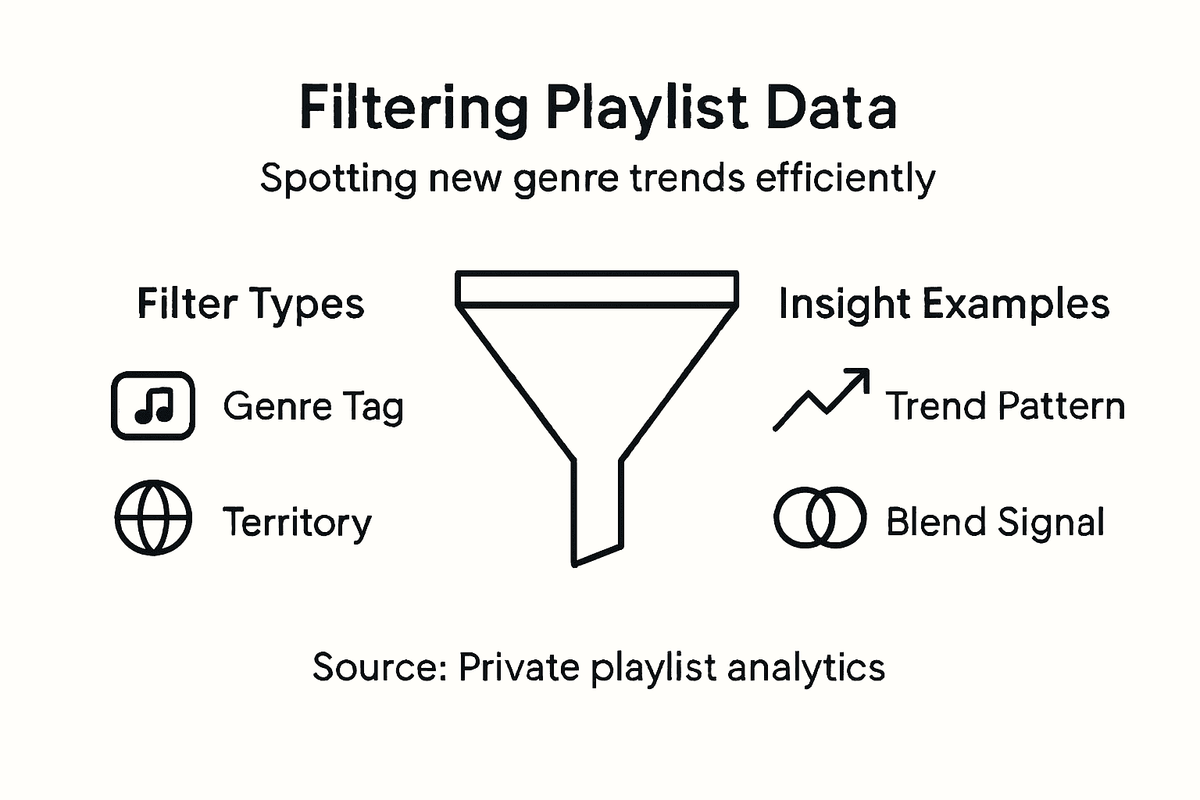
Filtering private playlist data is a critical step in uncovering meaningful musical insights across different geographic regions and genre landscapes. Your goal is to transform raw playlist information into targeted, actionable intelligence that reveals nuanced music consumption patterns.
Composite filters from music analytics platforms enable precise segmentation of playlist data through sophisticated metadata analysis. When filtering playlists, you'll want to focus on several key parameters:
- Genre classification tags
- Geographic location metadata
- Listener demographic information
- Playlist creation timestamp
- Streaming platform origin
To effectively filter playlists, configure multi-dimensional filtering criteria that allow granular exploration of music trends. Professional analytics platforms typically offer advanced filtering interfaces where you can combine multiple parameters simultaneously. This approach enables you to drill down into highly specific playlist segments - like alternative rock playlists from South American listeners under 35, or electronic dance music collections from European urban centers.
Important filtering strategies involve understanding how different platforms categorize musical genres and geographical territories. Some platforms use broad genre labels, while others provide hyper-specific subgenre classifications. Cross-referencing multiple data sources can help validate and enrich your filtering results.

Pro tip: Always validate your filter settings by sampling the resulting playlist collections to ensure the segmentation captures the intended musical landscape.
Compare common playlist filter parameters and their typical use cases:
| Filter Parameter | Typical Usage | Potential Insight |
|---|---|---|
| Genre Tags | Segment by musical style | Identify trending genres |
| Location Metadata | Group by geographic region | Spot regional music trends |
| Demographics | Target listener segments | Reveal age- and gender-based tastes |
| Creation Timestamp | Analyze historical patterns | Detect seasonal genre shifts |
| Platform Origin | Compare streaming service performance | Uncover platform-specific trends |
Step 3: Pinpoint emerging trends and genre blends
Identifying emerging music trends requires a sophisticated approach that goes beyond surface-level playlist analysis. Your objective is to uncover subtle genre mutations and cross-pollination patterns that signal innovative musical movements before they become mainstream.
Music trend tracking strategies demand a nuanced understanding of playlist dynamics and genre intersectionality. When analyzing genre blends, pay attention to several critical indicators:
- Frequency of cross-genre track placements
- Emerging artist collaborations
- Unexpected genre combinations
- Rapid playlist propagation across different regions
- Listener engagement metrics with hybrid genre tracks
To effectively pinpoint trends, develop multi-dimensional trend detection techniques that capture the complex interactions between musical styles. Professional music analysts look for subtle signals like recurring track clusters, unexpected genre migrations, and emerging artist networks that challenge traditional genre boundaries.
Advanced trend identification involves mapping genre intersection zones where traditional musical categories blur. These liminal spaces often represent the most exciting and innovative musical developments, revealing how listeners are actively dismantling rigid genre classifications and creating more fluid musical experiences.
Genre blending represents the future of music discovery - where boundaries become suggestions rather than strict rules.
Pro tip: Create visualization maps of genre interactions to help identify emerging trend vectors more effectively.
Step 4: Analyze influential curators and breakout artist activity
Pinpointing influential music curators and tracking emerging artist momentum requires a strategic approach that goes beyond traditional metrics. Your mission is to decode the complex ecosystem of playlist influence and artist discovery through sophisticated data analysis.
Curator influence mapping demands a multifaceted examination of playlist creation and propagation patterns. When analyzing curator impact and artist trajectories, focus on these critical indicators:
- Playlist follower growth rates
- Frequency of artist playlist inclusions
- Cross-platform curator reach
- Rate of playlist track rotation
- Early discovery of emerging artists
To effectively evaluate curator influence, develop comprehensive curator performance metrics that capture nuanced signals of tastemaker impact. Professional music analysts look for subtle indicators like consistent early artist identification, playlist diversity, and the ability to predict genre shifts before they become mainstream trends.
Advanced curator analysis involves mapping network influence dynamics that reveal how certain playlist creators function as critical nodes in music discovery ecosystems. These influential curators often operate as early-warning systems for breakthrough artists, identifying talent before traditional industry channels recognize their potential.
True music discovery happens at the intersection of data intelligence and human curation - where algorithms meet artistic intuition.
Pro tip: Track curator playlist evolution over time to identify those with the most consistent and predictive artist discovery capabilities.
Step 5: Validate findings with predictive analytics tools
Validating music trend discoveries requires sophisticated analytical techniques that transform raw playlist data into actionable insights. Your goal is to leverage predictive analytics frameworks that confirm and extend your initial genre trend observations.
Predictive analytics strategies enable systematic verification of emerging musical patterns through advanced computational methods. When validating trend findings, implement a comprehensive validation approach that includes:
- Statistical significance testing
- Machine learning trend confirmation models
- Cross-platform trend correlation analysis
- Longitudinal trend trajectory mapping
- Comparative genre momentum indicators
Professional music analysts develop multi-dimensional validation protocols that scrutinize trend hypotheses from multiple analytical perspectives. This approach involves creating sophisticated algorithmic models that can distinguish between momentary fluctuations and genuine emerging genre transformations.
Advanced validation techniques require integrating complex data sources that provide contextual depth to your initial trend observations. By cross-referencing playlist data with streaming metrics, social media engagement, and artist network dynamics, you can build robust predictive models that offer unprecedented insight into music evolution.
Predictive analytics transform raw data into strategic foresight - turning playlist observations into actionable industry intelligence.
Pro tip: Develop dynamic validation models that adapt quickly to changing musical landscapes and incorporate real-time data streams.
Gain a Competitive Edge by Unlocking Private Playlist Insights
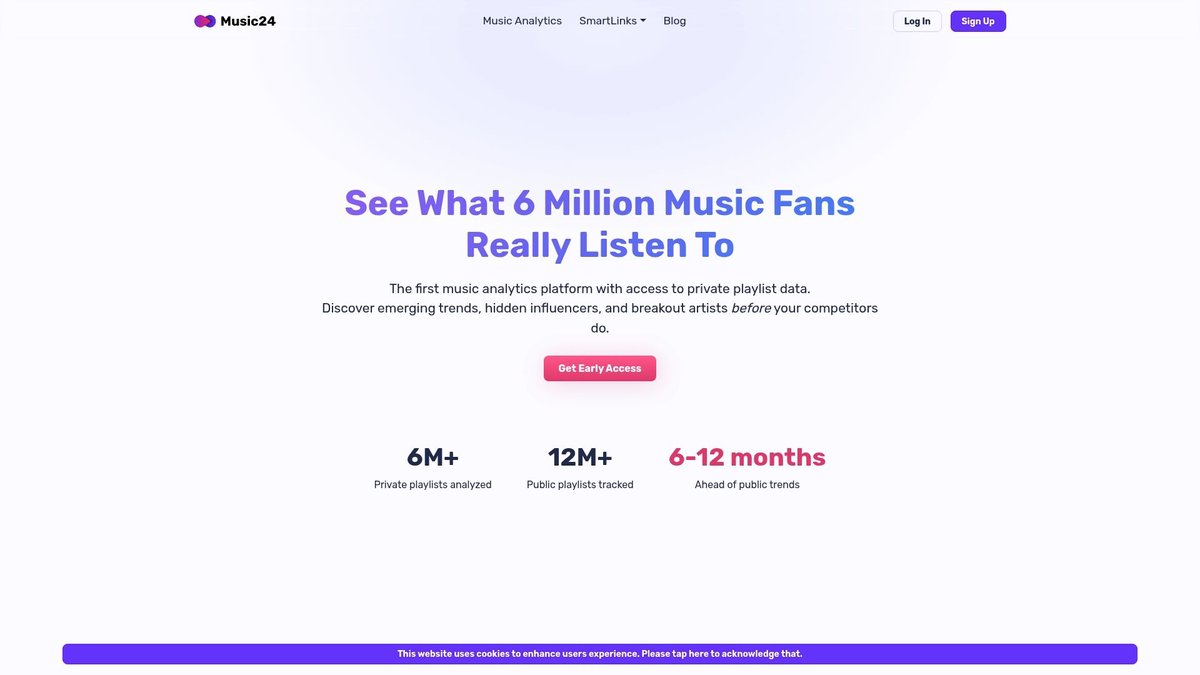
The challenge of accessing and analyzing private playlist data to identify emerging genre trends, influential curators, and breakout artists is a critical hurdle for music industry professionals. You want to move beyond surface-level public streaming stats and discover authentic music patterns hidden in the millions of anonymized private playlists. Concepts like dynamic permission management, multi-dimensional filtering, and predictive analytics demand advanced tools tailored to your strategic goals. Music24.com offers exactly that—a specialized music analytics platform designed to transform these complex tasks into clear, actionable insights.
With Music24, you gain exclusive access to private playlist data analytics that reveal nuanced genre blends, regional micro-trends, and curator influence long before these insights appear in traditional metrics. The platform’s predictive analytics help you validate emerging trends and track early artist momentum so you can make confident marketing decisions and secure breakthrough talent first. For professionals who seek a distinct advantage in music discovery, Music24 is the essential solution.
Explore how private playlist data powers advanced music trend detection.
Start uncovering genre innovations and rising stars today with Music24. Visit now and harness the power of private playlist analytics to elevate your music business strategy.
Frequently Asked Questions
How do I set up access to private playlist analytics?
To set up access, begin by obtaining developer credentials for the music streaming platform and implementing user consent mechanisms. Follow the OAuth protocols for requesting playlist permissions and ensure that you configure permission scopes accurately to retrieve the necessary data.
What parameters should I consider when filtering private playlists?
When filtering private playlists, focus on parameters like genre classification tags, geographic location metadata, listener demographics, and playlist creation timestamps. Establish multi-dimensional filtering criteria to explore music trends effectively and validate your settings by sampling the resulting playlists.
How can I identify emerging trends and genre blends in music?
To identify emerging trends and genre blends, analyze frequency of cross-genre track placements and monitor collaborations among artists. Implement multi-dimensional trend detection techniques to capture the interactions between musical styles, ensuring that you stay ahead of upcoming genre transformations.
What metrics are important for analyzing influential curators?
When analyzing influential curators, consider metrics such as playlist follower growth rates and the frequency of artist inclusions in playlists. Track these metrics over time to evaluate which curators consistently discover emerging artists and predict shifts in musical genres.
How can I validate my findings from analyzing private playlist data?
To validate your findings, utilize predictive analytics strategies that include statistical significance tests and machine learning models. Develop comparative genre momentum indicators and longitudinal trend mapping to ensure the robustness of your observations within 30–60 days.
What are some common challenges in accessing and analyzing private playlist data?
Common challenges include navigating complex authentication processes and ensuring user privacy while accessing data. Mitigate these challenges by choosing analytics platforms that offer clear documentation and support for compliance with privacy standards.
Recommended
- Role of Private Playlist Data: Complete Guide - Blog - Music24.com
- Why Analyze Playlist Trends for Early Artist Discovery - Blog - Music24.com
- Private Playlist Insights: Accelerating Music Discovery - Blog - Music24.com
- Playlist Trend Analysis: Unlocking Hidden Industry Insights - Blog - Music24.com
- BlockTone Records

