
Most American labels invest millions in data-driven scouting, yet less than 15 percent of emerging artists are discovered before their public breakout. Global A&R executives are redefining discovery by tapping into private music data, uncovering trends and talent hidden from traditional metrics. This article demystifies music data privacy, explaining how ethical and strategic analysis of sensitive playlists can reveal game-changing insights—giving your team a decisive edge in finding tomorrow’s stars before anyone else.
Table of Contents
- Music Data Privacy Defined and Debunked
- Categories of Music Data and Sensitivity Levels
- How Private Playlist Data Is Analyzed
- Legal Standards and Global Compliance
- Industry Obligations for Ethical Data Handling
- Risks, Limitations, and Data Protection Strategies
Key Takeaways
| Point | Details |
|---|---|
| Understanding Music Data Privacy | A&R professionals must balance data utility with individual rights, leveraging anonymization to gain insights while protecting user identities. |
| Categories of Music Data | Awareness of data sensitivity levels is crucial; understanding risks associated with primary, secondary, and sensitive data can guide ethical decision-making. |
| Private Playlist Data Analysis | Advanced analysis processes should employ pseudonymization and machine learning to derive actionable insights without compromising user privacy. |
| Legal and Ethical Obligations | Complying with global regulations and maintaining user trust through informed consent and robust anonymization strategies is essential for ethical data handling. |
Music Data Privacy Defined and Debunked
Music data privacy represents a complex landscape of technological, ethical, and regulatory considerations that impact how personal listening information is collected, analyzed, and protected. A&R professionals must understand that music data privacy goes far beyond simple anonymization—it encompasses intricate systems of consent, data handling, and user protection in an increasingly digital music ecosystem.
Privacy research reveals that music data privacy is multifaceted, emerging from sophisticated theoretical frameworks of personal information management. Traditional definitions no longer suffice in an era where playlist data, listening habits, and user preferences become valuable algorithmic insights. Modern music data privacy involves protecting individual user information while simultaneously enabling data-driven music discovery and artist development.
For A&R executives, understanding music data privacy means recognizing the delicate balance between data utility and individual rights. Private playlist data represents a goldmine of insights—revealing emerging genre trends, listener preferences, and potential breakout artists. However, accessing these insights requires robust anonymization techniques that protect individual user identities while extracting meaningful collective intelligence. This means transforming raw listening data into aggregated, depersonalized insights that maintain both statistical integrity and ethical standards.
Pro tip: Always implement multi-layered data anonymization strategies that strip personally identifiable information while preserving the rich contextual metadata that drives meaningful music discovery insights.
Categories of Music Data and Sensitivity Levels
In the complex world of music analytics, data is not a monolithic entity but a nuanced spectrum of information with varying degrees of sensitivity and potential impact. A&R professionals must understand the intricate categories of sensitive music data that shape modern music discovery strategies while maintaining rigorous ethical standards.
Music data can be categorized into several critical sensitivity levels. Primary data includes basic listening metrics like play counts, skip rates, and basic demographic information. Secondary data encompasses more complex insights such as playlist composition, cross-genre listening patterns, and user engagement trends. Sensitive data represents the most privacy-critical information, including personally identifiable listening preferences, detailed user behavior profiles, and potentially intrusive algorithmic predictions about individual musical tastes.
For A&R executives navigating this landscape, understanding data sensitivity means recognizing the potential risks and opportunities inherent in different data categories. Some music data types—like aggregated listening trends or anonymized genre preferences—pose minimal privacy risks and offer significant strategic value. Others, such as granular user behavior data or predictive listening models, require sophisticated anonymization techniques to protect individual privacy while extracting meaningful insights that can guide artist development and marketing strategies.
Pro tip: Develop a tiered data classification system that automatically flags and applies appropriate privacy protocols based on the specific sensitivity level of each music data category.
Here's a breakdown of music data sensitivity levels and their business relevance:
| Data Level | Example Metrics | Privacy Risk | Strategic Value |
|---|---|---|---|
| Primary | Play counts, skip rates | Low | Audience profiling |
| Secondary | Genre transitions, engagement trends | Moderate | Trend detection, artist planning |
| Sensitive | Individual preferences, predictive models | High | Personalized marketing insights |
How Private Playlist Data Is Analyzed
Private playlist data analysis represents a sophisticated process that transforms raw listening information into actionable musical insights. A&R professionals leverage advanced data privacy protection workflows to extract meaningful patterns while maintaining stringent ethical standards and individual user anonymity.

The analysis process typically involves multiple sophisticated stages. Pseudonymization becomes the critical first step, where personally identifiable information is systematically replaced with randomized identifiers. Advanced algorithmic techniques then parse playlist metadata, examining factors like track sequencing, genre transitions, cross-playlist similarities, and temporal listening patterns. Machine learning models can detect subtle trends—such as emerging artist crossover potential or nascent genre fusion points—that traditional analytics might overlook.
For A&R executives, private playlist data analysis goes beyond simple listening metrics. It involves complex computational techniques that transform raw data into strategic intelligence. Researchers use encryption protocols, consent management systems, and advanced anonymization technologies to ensure that individual user privacy remains paramount while extracting aggregate insights that can predict musical trends, identify potential breakout artists, and understand evolving listener behaviors across different demographic segments.
Pro tip: Implement a dynamic data anonymization framework that automatically applies multi-layered privacy filters while preserving the rich contextual nuances of playlist data.
Legal Standards and Global Compliance
Navigating the complex landscape of global data privacy requires A&R professionals to understand the intricate global data privacy regulatory frameworks that govern music data collection and analysis. Each jurisdiction presents unique challenges, demanding sophisticated and nuanced approaches to maintaining legal compliance while extracting valuable musical insights.
International data protection regulations create a multifaceted legal environment that varies dramatically across different regions. The European Union's General Data Protection Regulation (GDPR) remains the most stringent framework, requiring explicit user consent, robust anonymization techniques, and comprehensive data handling protocols. In contrast, United States regulations tend to be more sector-specific, with emerging state-level privacy laws like the California Consumer Privacy Act (CCPA) introducing additional layers of complexity for music data analytics professionals.
For global music analytics platforms, compliance means developing adaptive legal strategies that can accommodate diverse regulatory requirements. This involves creating flexible data processing systems capable of dynamically adjusting privacy protocols based on user location, implementing granular consent mechanisms, and maintaining transparent data usage documentation. Advanced music data platforms must integrate sophisticated geolocation-based privacy filters, ensuring that data collection and analysis methodologies remain legally compliant across multiple international jurisdictions while preserving the core value of insights generation.
Pro tip: Develop a comprehensive global compliance matrix that automatically maps data handling requirements across different international jurisdictions, enabling real-time legal risk assessment for music data analytics.
The following table summarizes major global music data privacy regulations:
| Region | Key Regulation | Main Requirement | Compliance Challenge |
|---|---|---|---|
| European Union | GDPR | Explicit user consent | Data portability, robust anonymization |
| United States | CCPA (California) | Opt-out mechanisms | Fragmented state-level laws |
| Asia-Pacific | Varies (Japan, South Korea, Australia) | Cross-border restrictions | Adapting to diverse local laws |
Industry Obligations for Ethical Data Handling
Ethical data handling in the music industry transcends legal compliance, representing a fundamental commitment to user trust and professional integrity. A&R professionals must navigate complex data protection practices that balance innovative analytics with individual privacy rights.
Informed consent emerges as the cornerstone of ethical data management. This means implementing transparent mechanisms that clearly communicate how music listening data will be collected, processed, and utilized. Advanced platforms must provide users with granular control over their data, including explicit opt-in processes, comprehensive privacy dashboards, and straightforward mechanisms for data withdrawal. The most responsible music analytics systems treat user data as a privileged trust, not an unrestricted resource to be exploited.
Beyond technical compliance, ethical data handling requires a proactive approach to potential privacy risks. This involves continuous risk assessment, regular privacy impact evaluations, and developing robust anonymization strategies that preserve the richness of musical insights while completely protecting individual identities. Music analytics platforms must implement multi-layered security protocols, including advanced encryption, secure data storage practices, and strict access controls that limit human interaction with potentially sensitive user information.
Pro tip: Create a comprehensive ethical data handling framework that integrates user consent, anonymization technologies, and continuous privacy risk monitoring into your music data analytics workflow.
Risks, Limitations, and Data Protection Strategies
The music data analytics landscape is fraught with complex privacy challenges that demand sophisticated risk mitigation approaches. A&R professionals must understand the nuanced data protection risks in music research that can potentially compromise individual user privacy and organizational credibility.
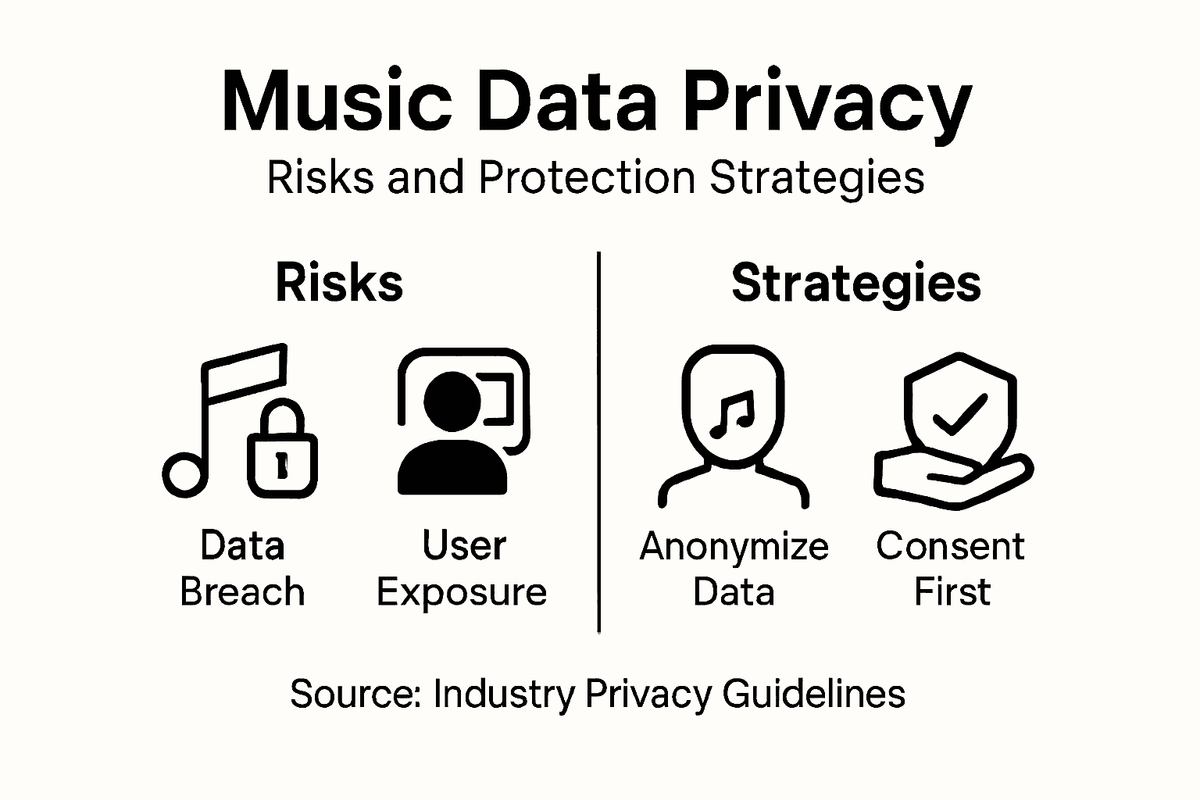
Potential risks in music data analytics span multiple dimensions. Technical vulnerabilities include potential data breaches, unauthorized access points, and algorithmic bias that might inadvertently expose sensitive user information. Reputational risks are equally significant—a single privacy violation can destroy user trust, potentially causing permanent damage to a music platform's brand reputation and user engagement. Advanced platforms must develop comprehensive risk assessment frameworks that continuously monitor and predict potential privacy vulnerabilities across technical, legal, and ethical domains.
Effective data protection strategies require a multilayered approach that goes beyond traditional security measures. This involves implementing advanced encryption protocols, developing granular access control mechanisms, and creating dynamic anonymization techniques that preserve data utility while completely protecting individual identities. Successful music data platforms must design systems that can automatically detect and neutralize potential privacy risks, using machine learning algorithms to identify unusual data access patterns, potential breach attempts, and unauthorized information requests in real time.
Pro tip: Develop a proactive privacy risk management framework that integrates automated threat detection, continuous compliance monitoring, and adaptive anonymization technologies into your music data analytics infrastructure.
Unlock Early Artist Discovery While Protecting Music Data Privacy
The challenge of balancing music data privacy with the need for actionable insights is crucial for A&R professionals aiming to identify breakout talent early. This article highlights how private playlist data holds immense potential when handled correctly through advanced anonymization and ethical data practices. Music24.com embraces these core concepts by offering a specialized music analytics platform that uses anonymized private playlists to reveal emerging trends, genre blending, and rising artists before they appear in public metrics or social charts.
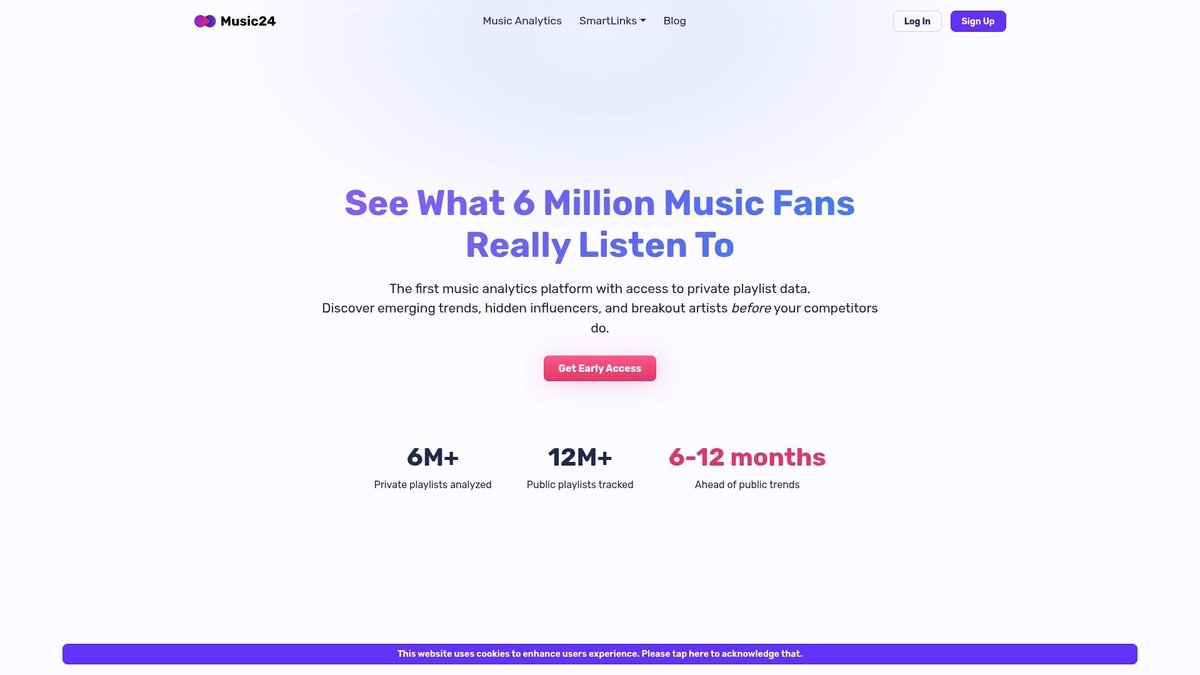
Discover how you can gain a competitive edge with detailed insights drawn from millions of private user collections at Music24.com. Do not miss the opportunity to enhance your artist scouting and marketing efforts with a platform designed to respect privacy while unlocking hidden musical patterns. Explore more about our innovative approach and data privacy commitment at Music24.com today and transform your music discovery strategy with confidence.
Frequently Asked Questions
What is music data privacy?
Music data privacy refers to the practices and regulations surrounding the collection, analysis, and protection of personal listening information in the music industry. It involves obtaining user consent and ensuring that data is anonymized to protect individual identities while allowing for valuable insights to be derived.
How is private playlist data analyzed to support artist discovery?
Private playlist data analysis involves several stages, including pseudonymization of user data and the use of advanced algorithms to detect trends and patterns. This process allows A&R professionals to extract insights while maintaining user anonymity, helping in identifying emerging artists and music genres.
What are the main categories of music data sensitivity?
Music data sensitivity can be categorized into three levels: Primary data (basic metrics like play counts), Secondary data (more complex insights such as genre transitions), and Sensitive data (identifiable listening preferences). Each category has different privacy risks and strategic values.
How do legal standards affect music data privacy practices?
Legal standards surrounding music data privacy, such as the GDPR in the European Union, require explicit user consent and robust data handling protocols. These regulations compel music analytics platforms to adapt their data processing systems to ensure compliance while still generating valuable insights.

